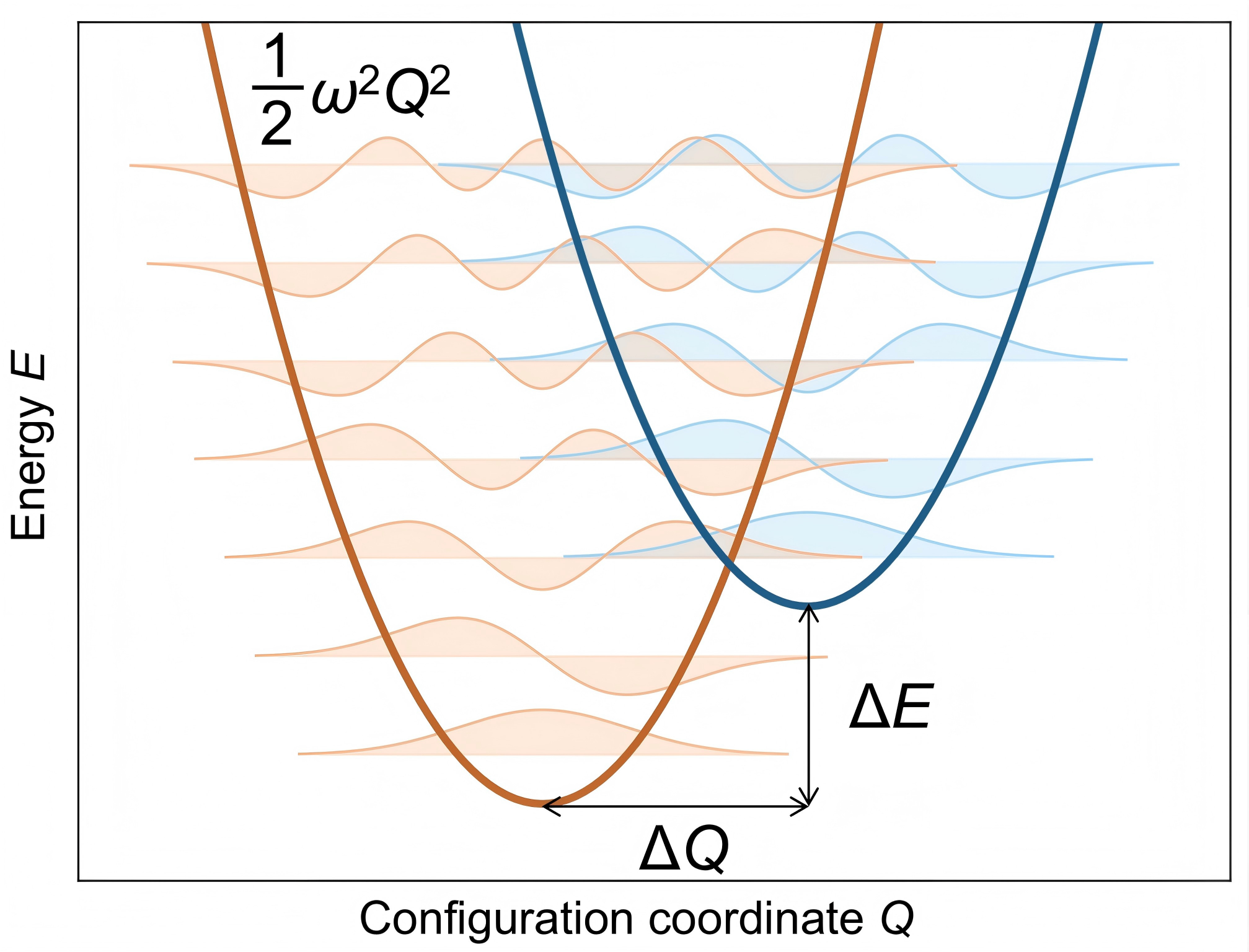
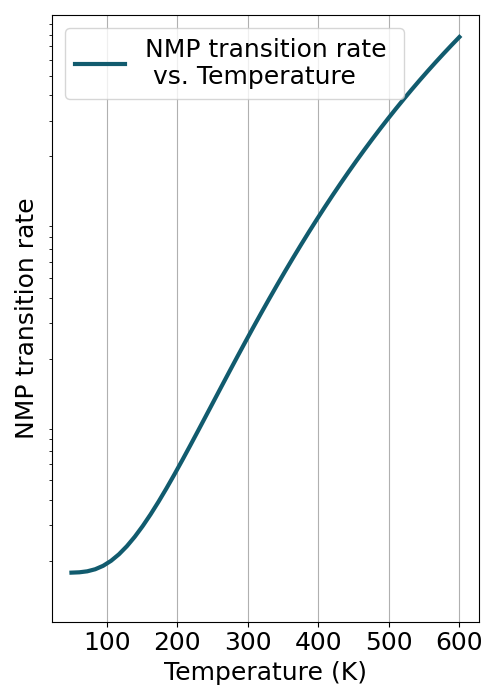
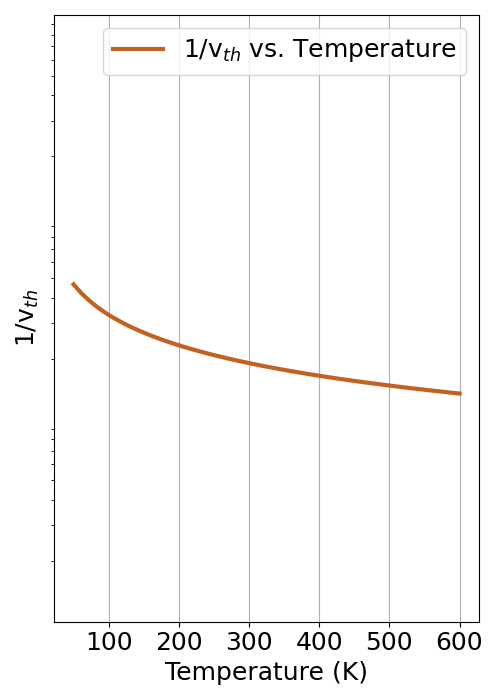
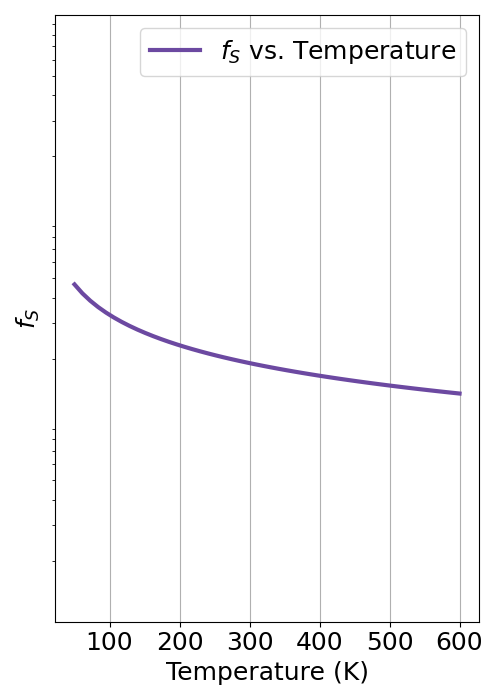
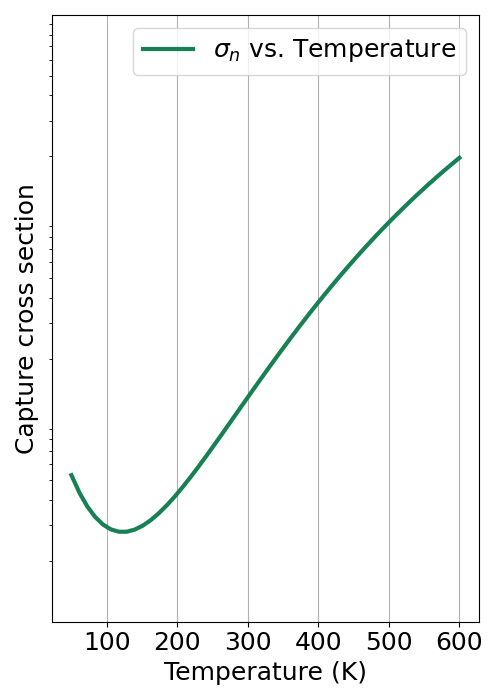
Carrier capture at defects probed by deep-level transient spectroscopy is a nonradiative multiphonon (NMP) electronic transition. Defects capture or emit carriers and change the charge state, so the initial and final states are associated with different equilibrium configurations, with a displacement \( \Delta Q \) along the configuration coordinate diagram, which is usually referred to as lattice relaxation. Under a single-phonon-mode approximation, with a vibrational frequency \( \omega \), the potential energy surfaces are constructed under the harmonic approximation, where \( U = \frac{1}{2}\omega^2 Q^2 \). The two potential energy surfaces are then separated by \( \Delta Q \) horizontally and by \( \Delta E \) vertically, where \( \Delta E \) is the defect transition energy associated with the defect level.
- Huang and Rhys, Proc. A 204, 406 (1950).
- Henry and Lang, Phys. Rev. B 15, 989 (1977).
- Huang, Contemp. Phys. 22, 599 (1981).